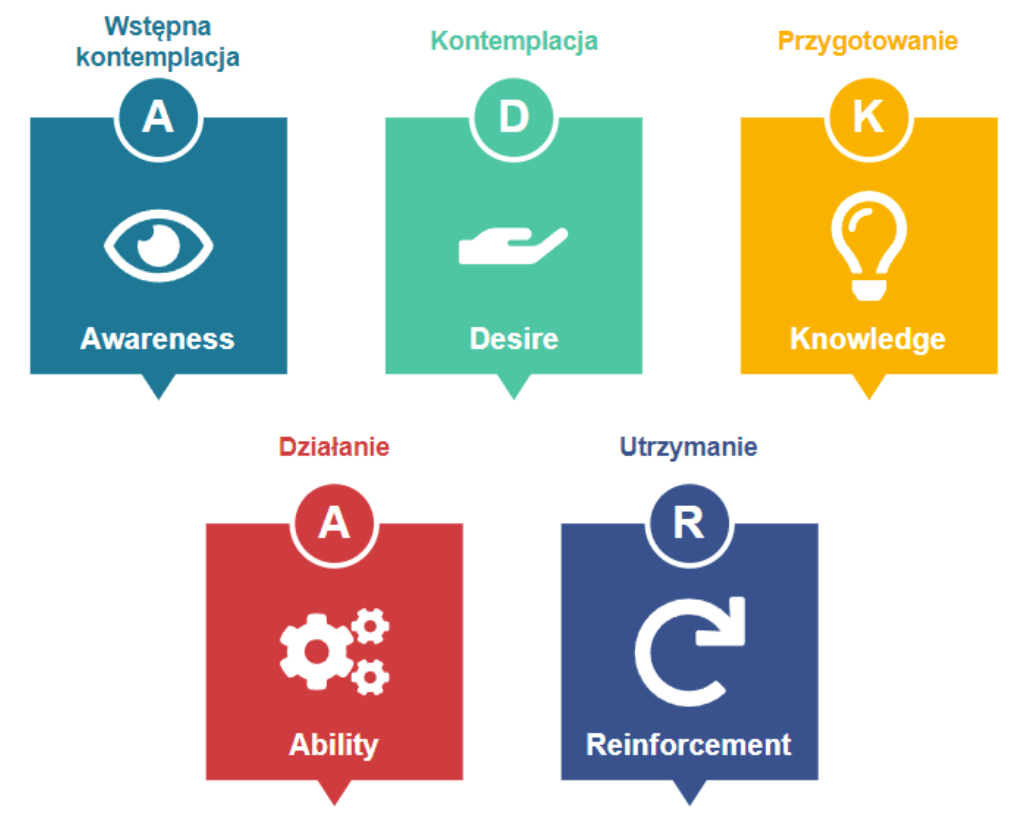
(awareness of the need for change).
Company employees should be aware that change is needed. You cannot change their work mode, habits, or beliefs with a single, top-down decision, nor can you monitor all employees to control whether they are implementing the changes.
Even the most necessary reforms will meet with reluctance if not explained to and understood by employees.
You need to meet regularly with employees, inform them about the purpose and positive effects of the changes, and convince them of their legitimacy.
(desire to support the change).
Once employees are aware of the necessity of changes, they should start supporting their implementation.
The ADKAR method recommends that everyone show a desire to participate in the transformations. You can motivate action by presenting the benefits as well as the threats that will occur if the change is not introduced.
(knowledge of how to change).
To transform a modern company, a precisely outlined plan of how and what to change is needed.
Employees also need knowledge so that they can easily function in the new professional reality.
Careful planning and providing appropriate training that will raise competencies and remove employee deficits will be helpful here.
(ability to demonstrate appropriate competencies and behaviors).
Changes may require some employees to abandon current duties for new ones, which can cause frustration and anxiety.
New skills need to be tested in practice through experiments, tests, and trials, and failures may occur. At this stage, the team leader’s involvement is crucial to support, motivate, praise, and accept failures naturally as part of the process.
(reinforcement to sustain the change).
Introduced changes should be reinforced to avoid returning to old habits. The most important thing is convincing the employees themselves to petrify the changes.
Employees should feel that their effort has been noticed and paid off, which can be achieved through discretionary bonuses, company parties, or integration trips. Monitoring implemented modifications to ensure consistency is also helpful