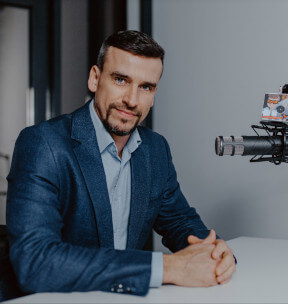




Communication is Your Work. Executive.
Communication Mastery for C-Level Leaders – a three-day, intensive program that strengthens your influence, cohesion, and authority.
At the management level, communication isn’t just about exchanging information – it’s a tool for building competitive advantage.
An effective and inspiring leader:
- Is an authority that inspires trust.
- Motivates action.
- Shapes a culture of collaboration and strategic cohesion.
- Influences talent engagement and retention.
Why Communication Is Your Work. Executive will transform your effectiveness as a leader?
- You will master crisis communication, which will save reputation (including yours) and your company's stock. You will practice merger, restructuring, and crisis scenarios – before reality surprises you.
- You will transform complex strategies into messages that motivate action. You will learn to explain finances, technology, and vision so that the supervisory board, employees, and the media understand and support your decisions.
- You'll build a personal leadership brand that opens doors and attracts talent. You'll develop an authentic public speaking style that builds investor trust and positions you as an industry expert.
- You'll learn to manage resistance to change before it paralyzes your organization. You'll master the psychology of transformational communication—how to maintain team engagement during challenging processes.
-
You'll develop the ability to influence without coercion—the key to gaining allies.
Case studies from real management teams will show you how to convince skeptical investors and motivate dispersed teams. - You'll gain an early warning system for problems within your organization. You'll learn to "read" emotions and moods before they escalate into turnover, strikes, or media scandals.
- You'll gain a safe space to test difficult communication decisions. Training with actors and feedback from other executives will help you develop an instinct for high-risk situations.
After this workshop, you’ll no longer fear difficult conversations and presentations – you’ll start using them as a strategic tool for effectiveness and strengthening your authority.
The training program
Three days, five strategic areas, case studies from both the Polish market and beyond, exercise materials, video analysis of speeches with actors, 360-degree feedback, and a certificate. Details below.
AREA 1: Strategic Expose – Communicating Vision and Standards
Strategic competencies:
- Translating complex financial, technical, and strategic data into clear narratives that inspire and engage.
- Building a coherent organizational message that connects values, mission, and goals.
- Effective communication at all levels – from the supervisory board to front-line employees.
- Structuring strategic presentations.
- Storytelling in financial performance presentations.
- Stakeholder mapping and message personalization.
- Simulation of a presentation before a supervisory board in a challenging performance scenario.
- Presentation of a transformation strategy for a skeptical management team.
AREA 2: Appreciation and Constructive Correction - Performance Management Through Communication
Strong teams need a leader who can both praise and correct. In this area, we provide the following knowledge: Advanced Feedback Competencies:
- Constructive correction without the risk of demotivation.
- Strategic appreciation as a tool for strengthening culture and talent retention.
- Communicating difficult personnel decisions: layoffs, demotions, and restructuring.
- The Theory of Self-Determination in Management Practice.
- Differentiating Motivators in Multigenerational Teams.
- Building Accountability Without Micromanagement.
- Analysis of Situations in Polish Management Boards.
- Dissecting Communication in M&A and Restructuring Processes.
AREA 3: Defending Decisions and Rejection at the Strategic Level
An executive leader must make difficult decisions and be able to defend them. That's why we'll share insights from the following areas: Rejection as a Strategic Tool
- Communicating unpopular decisions without losing support.
- Managing investor expectations and communicating with the media.
- Defending budgets and priorities without undermining team motivation.
- The No, But, Yes Model – refusal with an alternative.
- Turning constraints into opportunities.
- Building coalitions around difficult decisions.
- Refusing funding for "pet projects."
- Explaining decisions to close branches or product lines.
AREA 4: Mediation and Conflict Management from a Position of Authority
Management conflicts are an opportunity to strengthen relationships and processes. In this part of the training, we work on the following activities: Management Conflicts:
- Mediation between peer leaders.
- Managing tensions with the supervisory board.
- Escalation vs. de-escalation – consciously managing the tone of the conversation.
- Rapid response communication in image crises.
- Narratives in social media.
- Transparent communication with employees during crises and scandals.
- Thomas-Kilmann Model.
- Analysis of sources of organizational resistance.
- Early warning system – detecting conflicts before they escalate.
AREA 5: External Communication with Stakeholders and Partners and Personal Branding
Representing the Organization:
- Media Training – public speaking, interviews, press conferences.
- Thought Leadership – building the position of an industry expert.
- Crisis communication – effective communication with the media in crisis situations.
Intercultural competencies:
- Adapting communication style to global teams.
- International negotiations taking into account cultural differences.
- Virtual leadership – managing distributed teams.
Sign up for the next training
You receive: practical knowledge, a certificate, a manual, and lunch and coffee breaks are included.
Why does this program work?
- An intensive "social laboratory" - managerial role-play simulations with actors.
- Analysis of video recordings of your speeches.
- Communication algorithms and models ready for immediate implementation.
- Exchange of experiences among executive leaders.
- Networking.
- Professional feedback in an atmosphere of psychological safety and partnership.
Who is this program for?
- Management board members and company owners.
- Directors and department heads.
- Leaders responsible for strategic communication and organizational culture
Communication Is Your Work, Which Shapes Organizational Culture and Business Results
1. Organizational Culture Is the Language of Everyday Life
How leaders communicate with their team signals what values truly matter. Clear, consistent, and authentic communication strengthens a culture of openness and collaboration. A lack of transparency, in turn, breeds distrust and silos.
2. Communication Drives Engagement
Employees are more committed to the company's goals when they understand the purpose of the actions being taken. A leader who can share the vision in an inspiring way motivates teams to go above and beyond.
3. It influences efficiency and financial results
Gallup research shows that organizations with high levels of engagement – directly dependent on the quality of communication – experience higher profits, improved productivity, and greater customer loyalty.
4. Communication resolves (or deepens) conflict
At the executive level, difficult decisions and tensions are inevitable. How they are communicated determines whether conflict weakens the organization or becomes an impetus for growth and greater cohesion.
5. It's a tool for building competitive advantage
A culture of trust and dialogue attracts talent, strengthens collaboration between departments, and builds the company's external reputation – all of which translates into real business results.

Communication is the foundation – it's where the organizational culture begins, and through it, engagement levels, efficiency, and financial results are shaped.
Read reviews about the training
I recently participated in this training. I expected high quality (this is a Leaders Island trademark), but what happened during the training far exceeded my expectations! In a positive way, of course! I didn’t think the skills I developed there would be useful so quickly in real life.
The immense value of this training lies in the instructor, Błażej Pasiut, who works as a mediator and crisis negotiator! And the second instructor, whom I can’t really talk about ;-). After the training, you’ll understand why 😉
I highly recommend it!
Read recommendations of dozens of satisfied specialists.
Meet the mentor for this training
Problem-solving is my specialty.
I gained experience in conducting conversations in difficult situations, dealing with crises, and resolving conflicts in the most extreme way: as a mediator and crisis negotiator. For years, I have been professionally supporting others in making decisions that often put lives at stake.
Sign up for the training: Communication is Your Work. Executive.
Would you like to learn more about the training? Let's talk
- Katarzyna Raś
- Head of Learning & Partnership
- +48 669 530 113
- biuro@leadersisland.com
- You can also schedule a meeting online:
Would you prefer to get in touch via the form? You’re welcome to.
Please reach out to us via email at biuro@leadersisland.com through our form, or by calling phone: +48 669 530 113