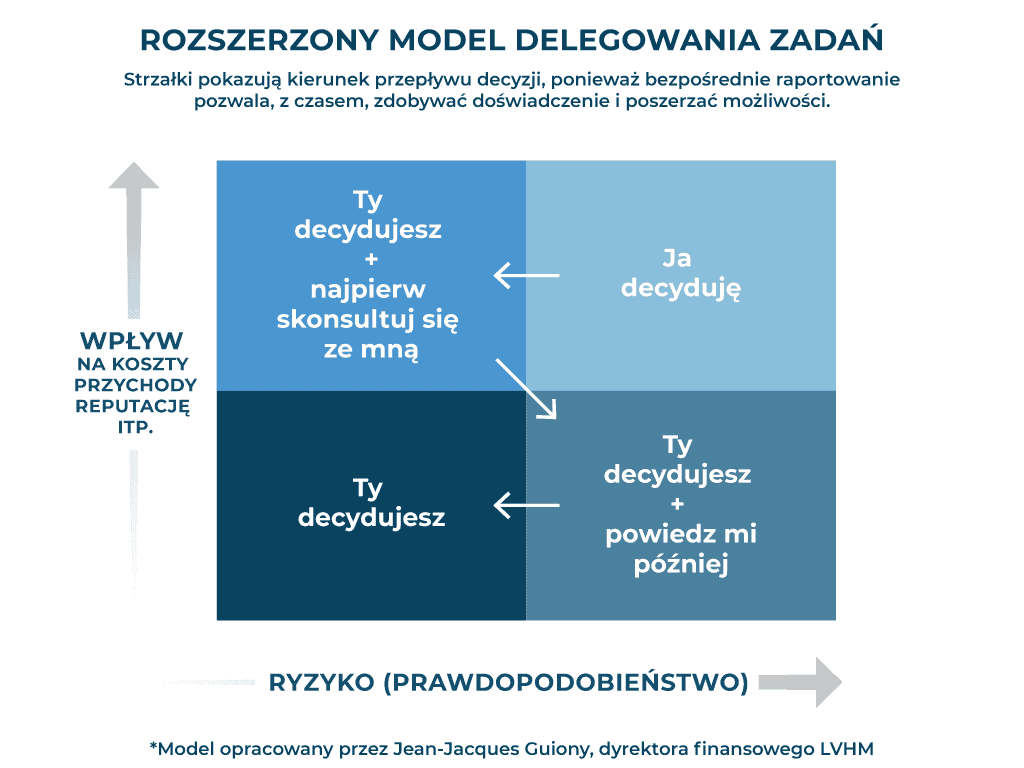
One of the key aspects of delegating tasks is their importance and the impact they can have on the business. The risk that may be associated with potential decisions made by the employee has led to the creation of a task delegation matrix, within which the employee’s responsibility for making decisions is varied, depending on their resources.
It is important that with the development of the employee and the acquisition of competencies by them, their ability to make independent decisions, including those related to risk, is expanded. As part of the exercise of using this matrix, it is worth sitting down before a quarterly evaluation, or a 1:1, and assessing what level your employee is at, and considering what you can do to change the level. Using the matrix will help you assess the employee’s work and motivation.
At this stage, all decisions are made by the leader. This is associated with a high risk of taking potential steps and their impact on the functioning of the company on many levels.
The second stage assumes a smooth transition to a gradual transfer of responsibility to the employee, however with the assumption that before making the final decision, everything will be analyzed by the leader. At this stage, the risk is smaller, while the impact of the decisions made on further functioning remains large.
At the third stage, the keyword is independence. The employee receives a task to complete, analyzes it themselves, gathers information, and decides what steps to take, only informing the leader of what they have decided. The risk is greater, and the impact is smaller.
The last stage assumes one hundred percent independence of the employee at every stage of task implementation and decision-making. Both risk and impact are low.