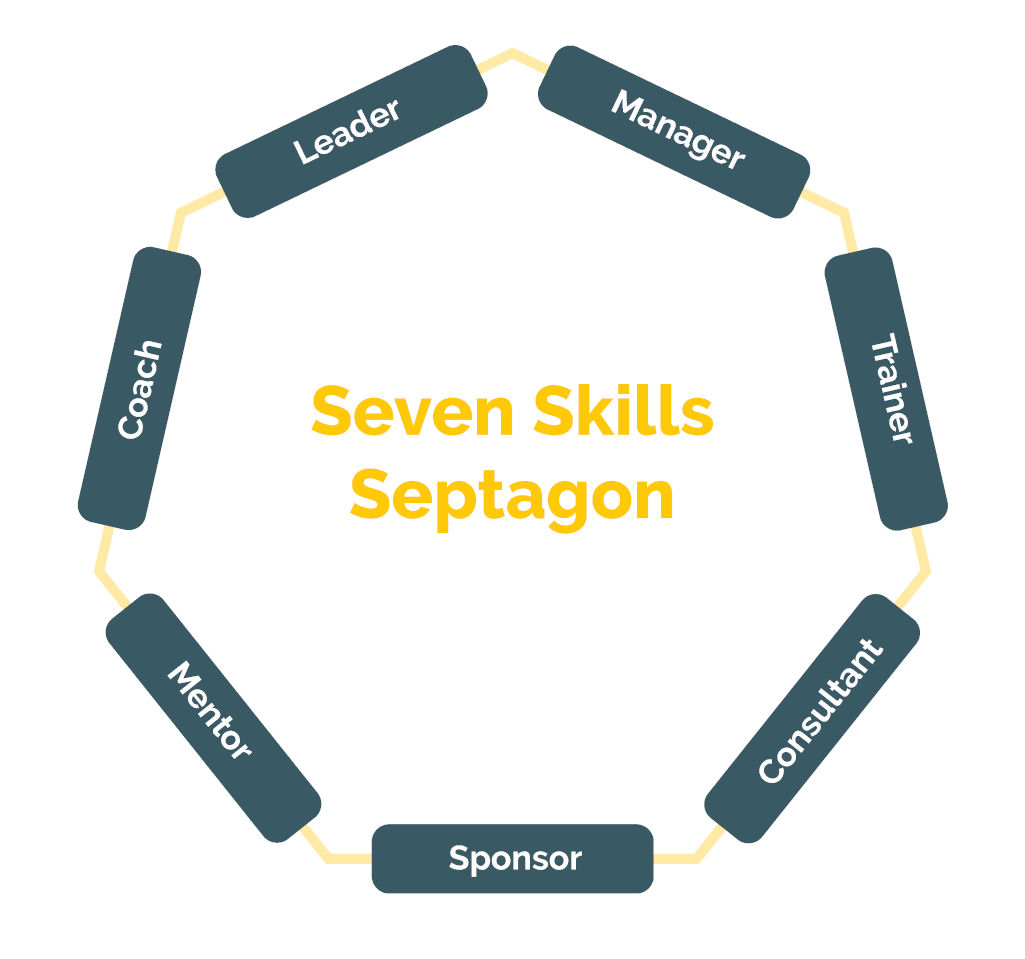
The Leadership Septagon is a concept of seven roles (each of which has its own scope of responsibilities), which a leader assumes to varying degrees and depending on the situation and context.
Each role requires being or not being a so-called SME – subject matter expert – a person possessing expert knowledge in a given area.
– Manager – creates processes, oversees the schedule, project scope, budget, roles, and responsibilities of team members. Gives feedback, is responsible for setting goals and monitors the path to achieving them [can be an SME].
– Trainer – trains, creates training plans, assesses development [is an SME].
– Consultant – shares knowledge, advises, analyzes, and designs changes, possesses the latest knowledge from their area [is an SME].
– Sponsor – is a guardian of the process, or the development of a given person in the organization, supports, helps gain contacts and financing for the venture [is not an SME].
– Mentor – shares knowledge, supports in development, points the way, recommends actions, steps; supports the “mentee” working on the basis of their own knowledge and experience [is an SME].
– Coach – supports in development by asking the right questions; supports the “coachee” working on the basis of the knowledge and experiences of that person [is not an SME].
– Leader – points the way, inspires, builds a vision, supports in development, removes obstacles [is not an SME].